
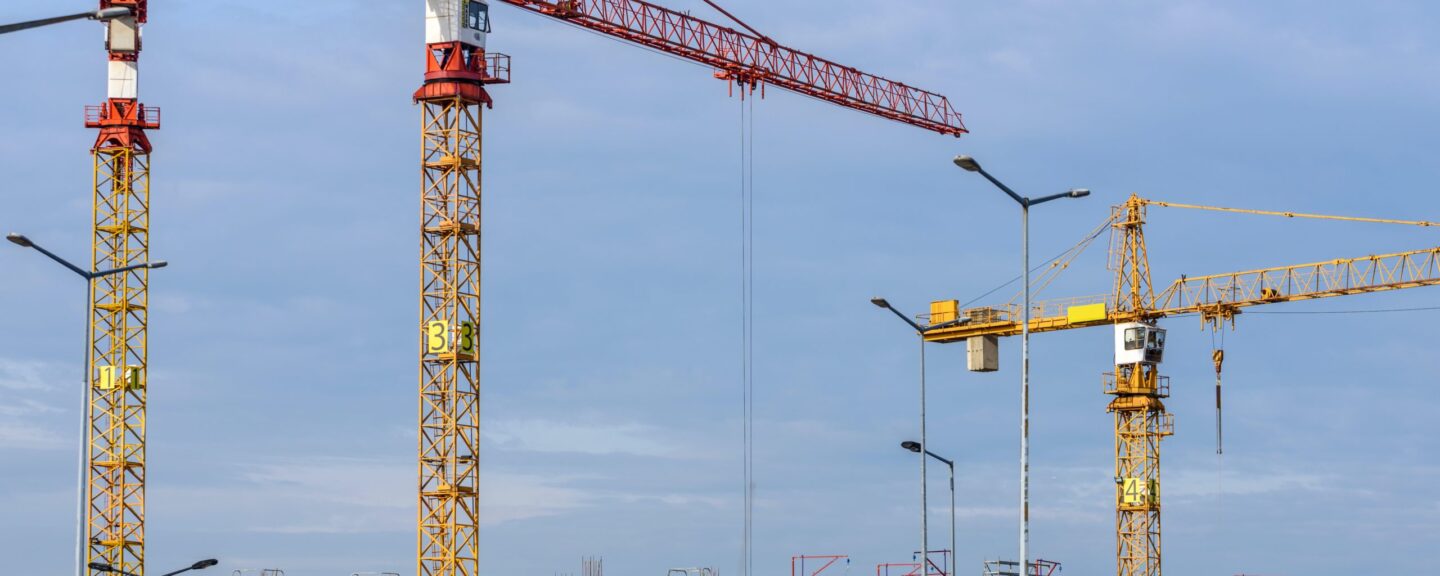
Of all branches of industry, construction was hit the hardest. Luckily, now construction is on the rise again. Over the past four years, these companies have shown growth rates that are structurally above those of the Dutch economy. Yet, we have not all worked on enough innovations in the time of contraction.
Now the limiting factor is finding enough people again. Meanwhile, I also read that the industry actually wants to become 50% more productive and reduce costs by 20%. Can this ambitious goal be achieved with technology? And how can you arm yourself against the next crisis?

Many construction companies are still recovering and trying to get back on their feet. Moreover, the margins for many construction companies remain under pressure. During the crisis years, many professionals lost their jobs and then returned as self-employed. Now, the demand is greater than the supply, so the self-employed are increasing their rates. Last year, construction costs increased by no less than 8.5%. In short, there is little room for miscalculation.
Yet, you also see signs that things are going wrong. For example, an apartment complex with shops and restaurants is under construction in my town. With the delivery in sight, the construction company goes bankrupt. According to the bankrupt entrepreneur, this is because the subcontractors (often self-employed) became more and more expensive and the costs could not be passed on to the clients. As a result, they tapped into reserves where eventually a huge gap remained.
When margins come under pressure, creativity has become an important aspect. Competition comes with innovation. Think: a new product or an optimized process that makes a positive contribution to the margin. And yet, most construction companies position themselves as competitively priced, rather than competitively innovative.
More revenue is not always good, since you cannot pay off your credit card directly from earned revenue. One of the options for changing the revenue model and improving margins is innovation. By outsourcing your infrastructure management to a partner like Intwo, your valuable IT team can focus on innovation. In the long term, innovation can reduce costs, increase quality and/or shorten construction time, which can, in turn, increase margins.
Construction is often described, certainly by outsiders, as a traditional industry which is not very keen on innovation. During the crisis, construction companies started to focus more on savings costs in order to achieve some margin. As a result, investments in new knowledge and technology were not forthcoming. This is the conclusion of a 2018 study by the University of Groningen (RUG) among four thousand members of Bouwend Nederland.
Innovations are about the development and application of new products, processes or services. However, the extent to which companies feel that they need to innovate in order to survive varies per company. Every entrepreneur has their reasons for innovating; for example, to meet customer needs or to be able to stand out from the competition.
Innovation can be an effective tool to increase turnover and profitability of the company, although we often consider it a major expense. That is not necessary at all. Namely, Microsoft offers the Power Platform with which we can create apps that automate certain things like time registration, quality documents (such as ‘clean ground’ declarations, safety checklists, access management to construction plans, etc.) and the deliveries of suppliers. Right now, almost everything is on paper, meanwhile we all have mini super-computers in our pocket. Intwo can help you bring your business into the future by freeing you of your legacy application landscape and modernizing your application infrastructure.
The Netherlands is becoming more sustainable and climate-proof. Construction plays a key role in that assignment. The Construction Agenda is a national innovation program for the entire construction sector in which the government, knowledge institutions, market parties and interest groups work together.
Despite the good intentions, only a handful of construction companies have started investing in innovation. This is apparent from a survey conducted by the Economic Institute for Construction (in Dutch: Economisch Instituut voor de Bouw). Only 30% of the construction companies surveyed are actually engaged in innovation. These companies invest 2.4% of their turnover in innovation. The ambition to achieve 20% fewer costs and 50% more innovation seems so difficult to achieve.
Many activities are repetitive. Consider, for example, legislation and procurement policy. You can see this as an obstacle and something on which you spend a lot of time. On the other hand, these are things that recur in all projects. In IT, we work with templates to roll out automated software and to turn servers on and off. This idea can be adopted by the construction. Investing in innovations is often seen as a cost item that you cannot declare to your client. While actually, if you can increase productivity as a result, you can save recurring costs. For example, McKinsey has calculated that innovation can increase productivity by 5-10 times. This way, innovation works for you.
Improving your productivity is an issue for all companies. In my industry, we often talk about the modern workplace and how you can automate repetitive work with user adoption and embrace all kinds of technology. I believe that construction can also benefit from standardization. One of the examples that you already see in construction is prefabrication. Houses are being built faster and faster because more is being made in a factory beforehand.
Let’s not assume that innovation and the use of technology is the holy grail. Having a clear strategy, collaboration and process control contributes to increasing the margin and increasing productivity. These are important success factors for the ambition mentioned in the first paragraph. If you are struggling with your cloud migration strategy, we can help. Fill out our CloudSCAN cloud assessment and let’s jumpstart your digital transformation.
Construction has to do with many whims. Consider the energy transition, sustainability and urbanization. Clients increasingly demand sustainable and innovative solutions. In addition, many parties may be working on a project together. Smart collaboration among the same documents reduces errors in version management.
The use of IT in the various phases is more important than ever. To reinvent the wheel time and time again is a waste of productivity, time and money. In addition, the construction industry is spending a serious part of their time on repair work. Technology such as IoT, robotization, 3D models, virtual reality and process automation can prevent this to a large extent. If all parties have access to the same data, the failure decreases. The continuous optimization of processes and the reduction of failure costs is a different way of steering than just saving costs.
Traditionally, construction competes for orders by price- even when margins are already thin. There are signs that a new crisis is coming. Cobouw, an independent Dutch weekly magazine for the construction industry, wrote an article about that. The Dutch government believes that the construction industry should better protect itself against this, and that is only possible if your margin improves. In short, we almost must look for opportunities to realize value in a different way. How can you be distinctive?
Nine technological trends for 2019 can be seen in the video above. Technology can increasingly work for you. This changes the roles and you no longer need people for certain activities. That is good news for the construction industry because currently those people are nowhere to be found. For some trends, you will see that you need different types of people.
Working together is not new, but our society is changing rapidly. These rapid changes require flexibility and adaptability from you and your company, however, it also brings opportunities; opportunities that arise through innovation. How do you achieve innovation? What can you do yourself and what is the added value of innovation through collaboration?
Construction traditionally works together a lot; multiple parties are involved in the implementation of a project. Yet, the mutual understanding is from top to bottom. Why not consider it a community chain? Carry out the project together and be creative together to ultimately deliver a good result. The Economic Institute for Construction’s research also shows while a reverse trend is visible, companies are consolidating, and the chain is becoming more difficult to work together.
The chain cooperation is stimulated with solutions such as Building Information Models (BIM), and software can play an important role here. The entire chain literally works together on the same version. If you really dare to work together and share knowledge together, this will be more sustainable in the long term and good for margins. You could even solve personnel challenges that way. Together, we see this as a challenge; not just a challenge for you alone.
Growth is not just a matter of course. It’s not a coincidence that some companies just happen to have the wind in their sails; they are entrepreneurs who have consciously chosen a different course. They anticipate the new reality. The focus is on innovation, value creation and collaboration, while supporting technology has been optimally used for this. They are the front runners on the path to the new era.
I believe the most important conclusion is that collaboration and technology can play a role in increasing construction productivity. The common thread is “go innovate” and start as small as possible. Also, involve all people, because it is the people on the construction site who see other things that can be optimized. Just like DevOps, let innovation and optimization be a continuous process.
Optimizing processes is another aspect. In particular, the entire construction process and collaboration with chain partners. Consider Building Information Modeling (BIM) software. Refer below for a brief introduction to this solution. Thanks to a BIM solution, you can improve cooperation and reduce failure costs. This increases the return on investment.
Long-term and constructive cooperation with the same clients and suppliers increases chances of success. As a result, we know where everyone stands, the benefits and quality, and we ultimately lower costs.
Let’s get the conversation started. By filling out our CloudSCAN cloud assessment, we can help jumpstart your digital transformation.
Construction companies are under constant pressure to improve productivity, cut costs, and deliver projects faster, all while dealing with thin margins and labor shortages. Technology helps address these challenges by automating repetitive tasks, improving collaboration between project partners, and reducing costly errors on site. Tools like IoT, 3D modeling, process automation, and Building Information Modeling allow construction firms to work smarter instead of just harder. Without adopting technology, companies risk falling behind competitors who are already using these tools to gain an edge.
Innovation gives construction companies a way to move beyond competing purely on price, which is a common habit in the industry. By investing in new products, optimized processes, or digital tools, firms can reduce recurring costs, cut down on rework, and shorten construction timelines. According to McKinsey, innovation can increase productivity by five to ten times. Even small investments, like automating time registration or digitizing safety checklists using platforms like Microsoft Power Platform, can lead to meaningful savings that directly improve margins over time.
Building Information Modeling, or BIM, is a technology/software that allows all parties involved in a construction project to work together on the same digital model. This means architects, engineers, contractors, and subcontractors are literally collaborating on the same version of a project, which drastically reduces errors caused by outdated documents or miscommunication. BIM improves cooperation across the entire supply chain and helps lower failure costs. When everyone has access to the same accurate data, the quality of the final result goes up and costly mistakes go down.
The construction industry has traditionally been seen as slow to innovate. A big reason for this is the financial pressure companies faced during and after the global financial crisis. During those lean years, most firms focused on cutting costs to survive rather than investing in new tools or processes. Research from the University of Groningen found that investments in knowledge and technology stalled during this period. On top of that, only about 30 percent of construction companies are actively engaged in innovation, investing just 2.4 percent of their turnover into it.
The construction industry is dealing with a serious labor shortage. Skilled workers are hard to find, and many who left during the crisis returned as independent contractors charging higher rates. This drives up costs and puts further pressure on margins. Technology can help fill part of this gap by automating tasks that previously required manual effort. Robotics, process automation, prefabrication, and digital tools can handle repetitive work, freeing up the people you do have to focus on higher value activities that truly need a human touch.
Microsoft Power Platform is a set of low code tools that allow businesses to build custom apps, automate workflows, and analyze data without needing deep programming skills. For construction companies, this is incredibly practical. You can create apps for time registration, safety checklists, supplier delivery tracking, access management for construction plans, and quality documentation like clean ground declarations. Most of these processes are still handled on paper in many firms. Digitizing them with Power Platform saves time, reduces errors, and makes information accessible from any device on site.
Construction projects typically involve many different parties, from architects and engineers to subcontractors and suppliers. When these teams work in silos, mistakes happen, and rework becomes expensive. By using shared digital tools like BIM software and cloud based platforms, all partners can access the same up to date information. This reduces version management errors, improves communication, and ensures everyone is aligned. Long term collaboration with the same clients and suppliers also builds trust, consistency, and shared knowledge, all of which lead to better quality and lower costs over time.
Most construction companies win projects by offering the lowest price, which often means razor thin margins and little room for error. Competing on innovation means differentiating yourself through smarter processes, better technology, or unique approaches that add value beyond just cost. This could mean faster build times through prefabrication, fewer errors through digital collaboration, or more sustainable construction methods. Companies that innovate can justify stronger margins because they are delivering something their competitors cannot, rather than simply undercutting them on price.
The construction industry is cyclical, and downturns hit hard. Companies that invest in technology and innovation during good times are far better positioned to weather a crisis. By automating processes, reducing failure costs, and improving collaboration, firms can maintain healthier margins even when demand drops. Technology also makes it easier to scale operations up or down without the heavy overhead of manual systems. The key takeaway is that building resilience through digital tools and efficient processes is not a luxury. It is a form of long term protection.
Intwo helps construction companies by modernizing their IT infrastructure and freeing them from outdated legacy systems. By outsourcing infrastructure management to Intwo, your internal IT team can shift its focus toward innovation and business improvement. Intwo also offers cloud migration support, Azure managed services, and tools like Power Platform to automate day to day processes. Their CloudSCAN assessment gives you a clear picture of where you stand today and what steps to take next. It is a practical starting point for any construction firm ready to embrace technology.

Rest assured. We've got you.
Let's get in touch and tackle your business challenges together.