
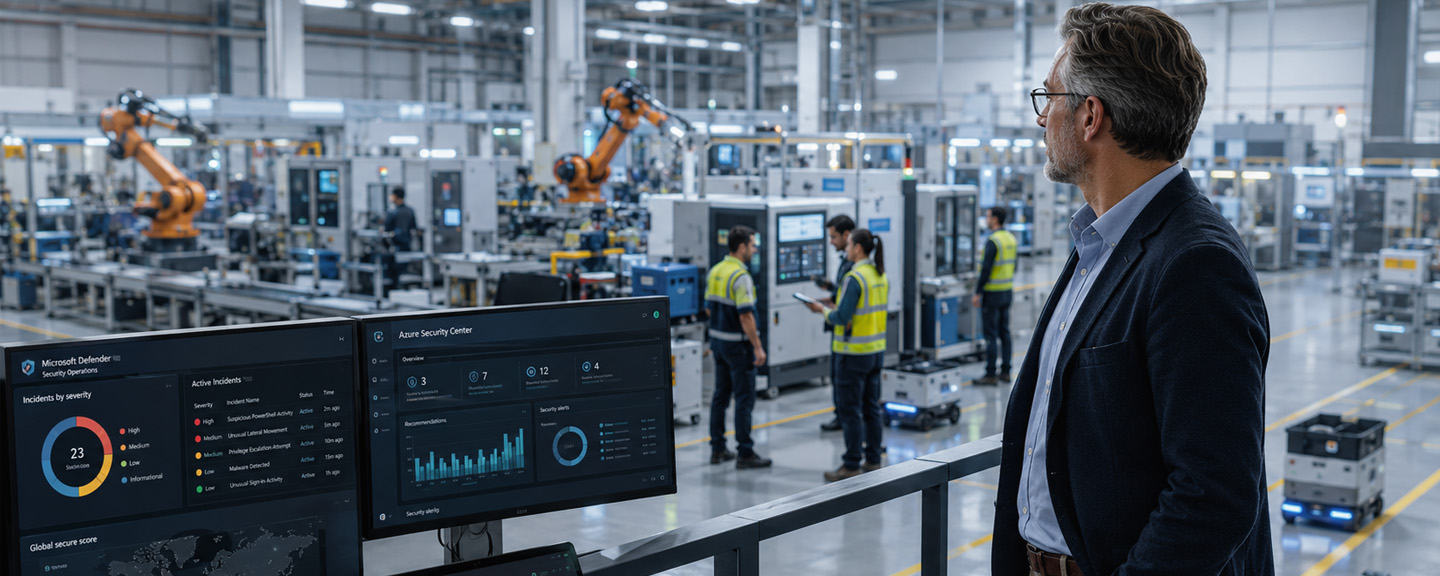
It arrives through a contractor credential, a misconfigured remote access tool, or an unpatched HMI sitting on the same flat network as the ERP. By Monday, work orders are frozen, the MES is read-only, and the board wants a timeline. For mid-market manufacturers, the operational and financial cost of running security as a part-time responsibility has quietly outgrown the savings.
In this article, leadership will gain a clear understanding of where in-house security models break down at this scale, what a managed security partnership actually changes, and how to evaluate one without falling for the usual sales theatre.
Manufacturing has held the unenviable position of most-attacked industry in IBM’s X-Force Threat Intelligence Index for several consecutive years, and the reasoning is operational, not theoretical. Production environments cannot tolerate downtime, making ransom demands more likely to be paid. OT assets such as PLCs, SCADA historians, and engineering workstations were built for uptime and longevity, not for monthly patch cycles. Many sit on networks that were flattened years ago to make integration with ERP and MES easier, and that decision has aged badly.
The threat profile has also shifted from opportunistic to deliberate. Initial access brokers now sell footholds into specific manufacturers by name. Affiliates of well-known ransomware operators study supplier dependencies before encryption, as documented in CISA’s joint advisories on the sector. The result is a class of attacker that understands the cost of a 48-hour stoppage on an automotive Tier 2 better than most of the people running the plant.
The mid-market sits in a difficult middle ground. The estate is complex enough to attract attackers, but the security function is rarely sized to match. A typical setup includes a small IT team carrying both infrastructure and security responsibilities, an OT environment owned by engineering, and a growing cloud footprint added during ERP modernization or D365 migrations. No single person has full visibility across all three.
Hiring your way out of the gap is harder than it looks. Experienced SOC analysts, OT-aware incident responders, and identity engineers are scarce and expensive, and they tend to leave mid-market roles for larger enterprises or pure-play security firms within eighteen months. Spending on security tools grows in parallel: EDR, SIEM, vulnerability scanners, identity governance, cloud posture management, each generating alerts that nobody has time to triage. A CISO at a precision components manufacturer recently put it plainly in a working session: “We have the tools. What we do not have is anyone watching them at 2 a.m.”
That sentence captures the real exposure. Security maturity in this sector is no longer measured by tools deployed; it is measured by minutes to containment.
A credible managed security engagement does three things that an internal team at this scale generally cannot sustain. First, it provides continuous monitoring backed by tiered response commitments. The practical test is whether critical incidents trigger analyst action within fifteen minutes, high-severity events within an hour, and lower tiers on the same business day. Anything loose is monitoring in name only.
Second, it brings depth across the disciplines that mid-market teams cannot keep in-house full-time: threat detection tuned to manufacturing telemetry, vulnerability assessment that respects change windows on production assets, identity protection that closes the contractor and vendor access gap, and cloud security posture management for the Azure and Microsoft 365 estate that ERP modernization has expanded. Bringing these capabilities under one operating model is precisely where our managed cybersecurity practice is built to support manufacturers, and it removes the integration tax that fragmented vendors create.
Third, and perhaps most importantly, it shortens the path from detection to containment by removing the handoffs. A managed partner that already understands the manufacturer’s MES, ERP, and Azure estate, and that maintains documented runbooks for the critical processes, will act in minutes where an outsourced helpdesk waits for a ticket to be reassigned. This is also where Microsoft-native security tooling, deployed as part of a broader Azure managed services engagement, pays back the investment, because the same telemetry feeding the cloud platform feeds the response.
A useful pressure test to apply internally: if the MES went offline at 6 a.m. on a Tuesday, who picks up the phone, what is their committed response time in writing, and do they already hold the architecture diagrams? If any of those answers are uncertain, the current model is the risk.
When assessing providers, four areas separate substance from packaging. Response SLAs should be tiered, contractually committed, and tied to severity definitions the manufacturer agrees with. Sector fluency matters; a partner that has run incident response inside a discrete or process environment will not confuse a historian alert with a workstation alert. Compliance coverage should map to the frameworks the business is exposed to, including ISO 27001, SOC 2, GDPR, and increasingly NIS2 as outlined by ENISA for European operators. Finally, the engagement should include continuous improvement rather than static monitoring.
The case for managed security in mid-market manufacturing is no longer about cost arbitrage or filling a skills gap. It is about closing the time between a foothold and a full production stoppage, with a partner that understands the OT, ERP, and cloud realities of the sector. Four points to carry into the next leadership conversation: threat actors are now manufacturer-specific, the in-house model breaks at this scale, value is measured in minutes to containment, and evaluation should focus on response SLAs, sector fluency, compliance fit, and continuous improvement rather than tool inventories.
The most useful next step is a structured assessment of where detection and response time would actually land today under a credible attack scenario. Our cybersecurity advisory team works with manufacturers on exactly this assessment, and the output is a clear view of the gap, not a sales document.

As Regional Information Security Officer, I oversee cybersecurity operations and MSSP/SOC services, ensuring 24/7 protection for our organization and clients. I develop and implement security policies, deliver awareness training, manage incidents, and help clients maintain regulatory compliance to reduce risk and strengthen resilience.

Rest assured. We've got you.
Let's get in touch and tackle your business challenges together.