

Looking at manufacturing specifically, which was already incredibly optimized, this sector has managed to double its productivity growth over the same period. This presents the construction industry with both a challenge and an opportunity.
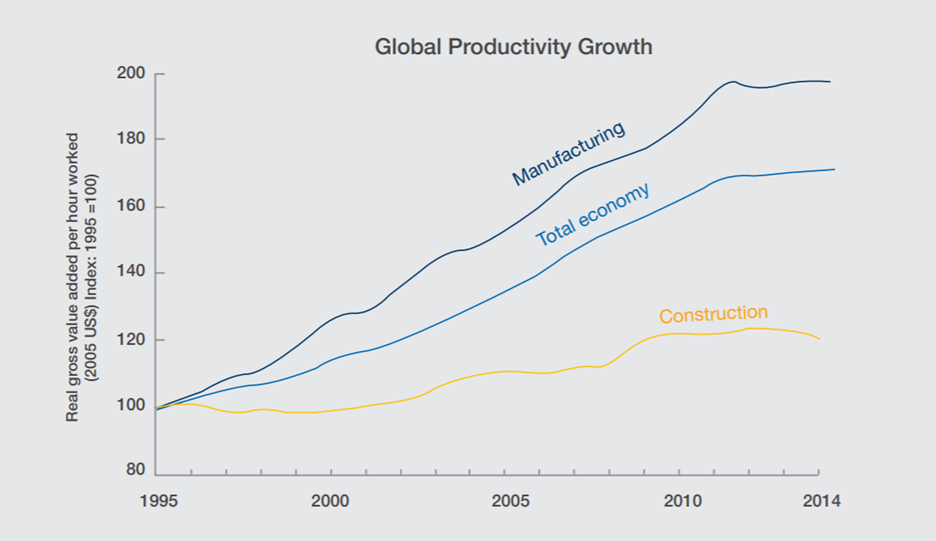
1. According to McKinsey, if construction’s productivity had grown at the same rate as the global economy the added value would equate to $1.6 trillion.
2. The second reason is linked to two deeply rooted challenges: cost and schedule overruns. Examining the accompanying graph, the average delay for a construction project is 20 months with an average cost overrun of 80%. For such a low-margin industry, with single-digit percentages, these overruns are extremely problematic but also present the construction industry with the chance to do things differently.
3. This industry is also one of the world’s most undeveloped when it comes to technology and invests far less in IT than other sectors.
4. Several mega-trends also have the potential to profoundly impact the construction sector, including ageing infrastructure, population growth outstripping capacity growth, sustainability, changes in the way we engage with the workforce, evolving politics, and regulatory pressures.
Whether it’s automation for improved productivity and performance, cloud-based software for greater collaboration, or the use of digital technology for onsite risk management through offsite manufacturing; digital transformation offers a host of qualitative benefits across the value chain. Most business leaders, however, agree that the biggest advantage will be experienced in the field of project management and performance.
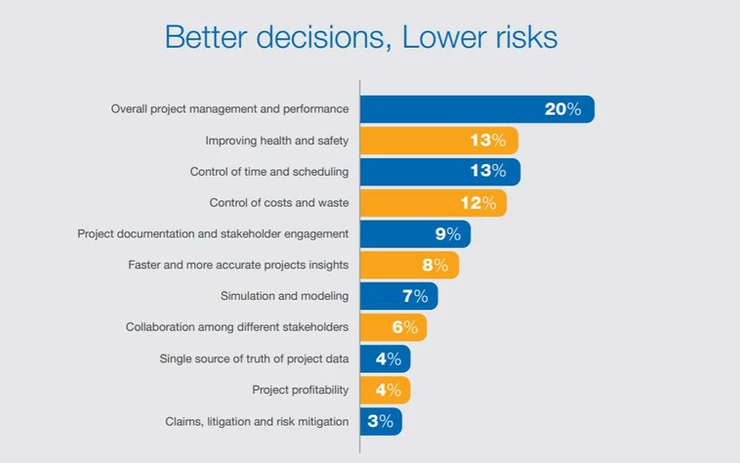
It’s really people working together that create great buildings, thus, a unique advantage is manifested when bringing together all relevant project stakeholders from the get-go. By getting all brains in the game, we can optimize what we need to do and ensure we have real-time connectivity between what we are doing on site and in the office.
Remaining consistent with the topics and studies discussed so far, the most important transformation areas for the construction industry are people. For this reason, when talking about the first steps towards digital transformation they must be discussed in relation to this area.
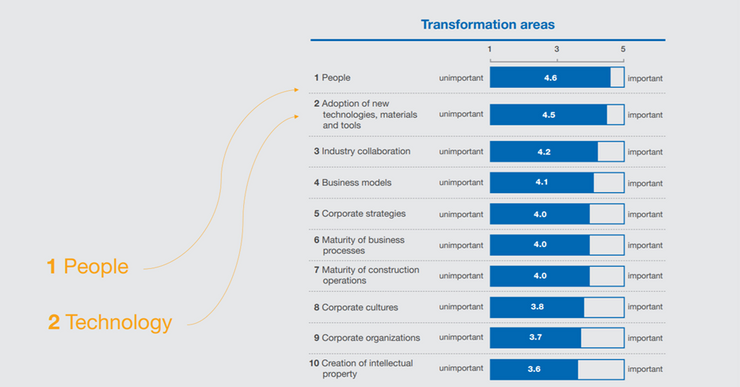
1) Help people adapt to new technology, new thinking, and new working methods.
Change in any organization will always face resistance, with this, we can be certain. In the construction industry, legacy procedures still dominate, and for many, the perception of migrating to a new construction management software seems almost antithetical to “the way things are done”.
However, there is no doubt that within this soon-to-be obsolete paradigm of doing things, frustration with existing project delivery systems and processes can run high in any project. As a result, more and more companies are turning to construction management software, and by proxy, leaner digitalized management systems.
After diving into the features and benefits of different construction management software available on the market, and carefully selecting the best one for their business, the next step is to get their people to change their way of working, accepting the new software, and finally actually using it.
Adopting a new software is not only a shift in the workflow but also a shift in the way of thinking and working methods, and though there is a learning curve, the pay off is well-worth the effort.
2) Help people communicate and collaborate efficiently with a true platform.
A vital strategic imperative heading forward is to ensure that your organization moves from desktop into Cloud and Mobility, and that you take your people from fragmented, disconnected offline tools and connect them on a unified platform supported by data and business intelligence. By doing so, your teams can be much more data-driven, much more connected, and much more collaborative, with the end result inevitably leading to a company-wide, and by extension, industry-wide increase in productivity.
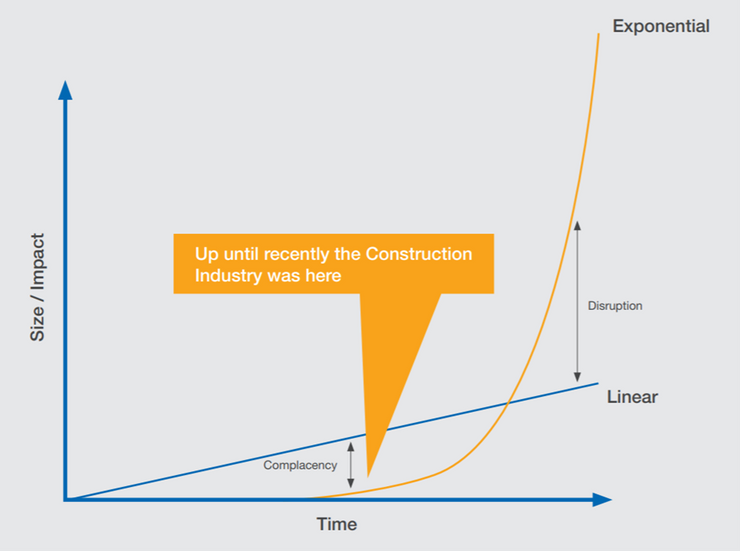
The data-based world is moving exponentially, but the way we think, and the way traditional organizations operate is still linear. As a result, most industries find themselves in a mode of complacency, so when an exponential trend appears they are immediately disrupted. Unfortunately, when this occurs it is often too late to respond.
Historically, the construction industry has been positioned in the same complacent segment. For it to survive and thrive, however, organizations need to respond proactively and in strategic ways to avoid being swept over by future exponential trends.
BIM allows an organization to unlock the true value of their data and that is why it is critical to implement the right solution when embarking on your digital transformation journey. When it comes to data, we are really talking about three aspects: the central database, real-time access, and data analytics.
1) Cloud-based central database. A central database needs to sit at the core for the data we mostly see today is collected in silo tools.
2) Real-time access. Real-time access to information is critical. Most construction projects today run in a reactive nature due to lacking real time integration to data.
3) Data analysis. For data analysis, we need to be able to have dashboard capabilities in which we can drill down to the relevant data and insights at any point in time and with speed.

The building lifecycle and workflows need to be connected since, as construction processes are causal by nature, if your teams use different applications for different specific processes and, as often happens, work orders and plans change, the knock-on effect can be lost time, budget overruns, and unforeseen challenges. Digital platforms that allow for instance connectivity can help to drastically cut such project challenges.
Imagine starting in the planning phase with such connectivity with all relevant stakeholders. This would mean that the instance a design is changed, changes in quantity takeoffs and costs can be seen immediately, or when a project owner suggests changing course, that the effect on cost, time, and final outcome can be calculated instantly. This is the power of connectivity.
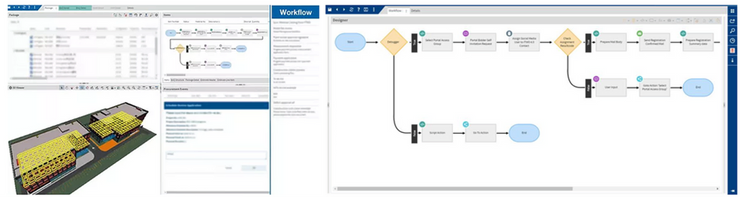
When these three pillars are not integrated, teams are not able to fully comprehend the impact of any change, any action, and any decision on scheduling, budget, and timelines.
Subsequently, our beloved projects can be an inefficient and risky environment to operate in.
To drive our business to become more productive, connect these three pillars, and witness the manifestation of exponential growth in your company’s productivity. A unified platform would be an ideal solution as on top of the enterprise platform, it has ample purpose-specific and integrated applications that enable different team members to do their work. These applications are accessible over tablets, phones, desktops, wherever and whenever. When you have such a platform in place, your stakeholders can collaborate easily, solve problems quickly, and create value effectively and efficiently.
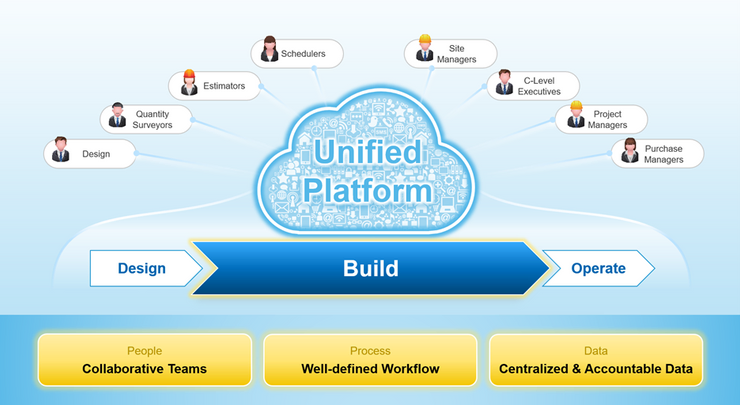
RIB 4.0 is the enterprise 5D BIM solution for contractors, developers and business owners who want to enhance every aspect of their digitalization journey. Featuring next-generation technologies including building information modelling, business intelligence (BI), and cloud functionality; RIB 4.0 is designed to connect people, processes and data for streamlined workflows and improved collaboration and productivity.
To learn more about RIB 4.0 and how it can help digitally transform your construction business, speak to our team today.
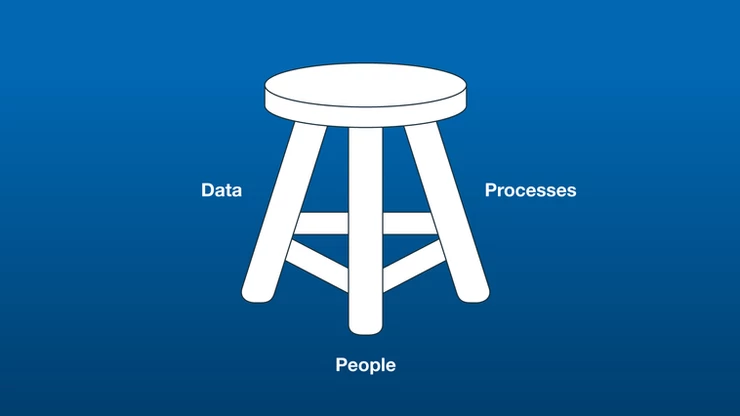
The three pillars are people, data, and process connectivity. People focuses on getting stakeholders engaged from the outset and helping teams adopt new ways of working through unified cloud platforms. Data involves establishing a cloud-based central database, enabling real-time access to project information, and providing dashboard-driven analytics for informed decision-making. Process connectivity means linking the entire building lifecycle so that changes in design, cost, or scheduling are instantly visible across all teams and disciplines involved in a project.
Construction has historically been one of the least digitized industries globally. Productivity growth has significantly lagged behind sectors like manufacturing over the past two decades. Several factors contribute to this: fragmented project teams using disconnected tools, deeply embedded manual processes, resistance to changing established workflows, and the complexity of coordinating multiple stakeholders across different phases of a project. The industry also operates on tight margins, which can make organizations cautious about investing in new technology without clear and immediate proof of return.
When these three pillars are integrated, teams gain a complete, real-time understanding of how any change, action, or decision affects scheduling, budget, and timelines. Without integration, project information sits in silos, decisions are made on outdated data, and the knock-on effects of design or scope changes go undetected until they cause delays or cost overruns. A connected approach allows stakeholders to collaborate from the planning phase onward, ensuring that quantity takeoffs, cost estimates, and schedules update instantly when project parameters change.
Most construction data today is collected in siloed tools that do not communicate with each other. A cloud-based central database consolidates this information into a single source of truth accessible to all authorized stakeholders regardless of location. This eliminates delays and errors from teams working with different versions of plans, budgets, or schedules. It also enables real-time analytics and dashboard reporting, giving project managers and leadership the visibility they need to make timely, informed decisions across the entire project lifecycle.
Most construction projects operate reactively because teams lack real-time integration with critical data. By the time issues are identified through manual reporting or periodic reviews, delays and cost overruns may already be embedded. Real-time data access changes this dynamic by giving project teams current information on costs, schedules, resource allocation, and site progress at any moment. This allows teams to course-correct before problems escalate, reducing the risk of budget blowouts and schedule slippage that have historically plagued the industry.
BIM enables construction organizations to unlock the full value of their project data by creating a digital representation of the physical and functional characteristics of a building. When implemented through the right platform, BIM connects design, cost estimation, scheduling, and project management into a unified workflow. This means that when a design element changes, the impact on quantities, costs, and timelines is calculated automatically. BIM serves as the data backbone for digital transformation, connecting teams and processes in ways that traditional, document-based approaches cannot achieve.
Technology alone does not drive transformation. Construction is fundamentally a people-driven industry, and even the best platforms will fail if teams do not adopt them. Implementing new software requires a shift in both workflows and mindset. Organizations must invest sufficient time and resources in training, change management, and user support to ensure adoption succeeds. Getting stakeholders involved early in the selection and implementation process builds ownership and reduces resistance. Without genuine buy-in from the people who use these tools daily, digital transformation stalls.
Disconnected tools create silos where information is trapped within individual applications. When teams use different software for estimating, scheduling, procurement, and site management, changes in one area do not automatically flow to others. A unified platform connects all these functions, ensuring that every stakeholder works from the same data and that changes are reflected across the entire project in real time. This reduces miscommunication, prevents costly rework, and gives leadership a consolidated view of project performance across all active sites.
Cost and schedule overruns are among the most persistent challenges in construction. When project data is fragmented across disconnected tools, teams cannot see the full impact of changes on budgets and timelines until it is too late. A design modification, for example, may affect material quantities, procurement schedules, and labor plans, but if these systems are not connected, the downstream effects go unnoticed. Digital integration links these processes so that every change is immediately assessed for its impact on cost, time, and project outcomes.
Intwo, as part of the RIB/Schneider Electric group, offers RIB 4.0 (MTWO), an enterprise 5D BIM solution designed for contractors, developers, and business owners pursuing comprehensive digitalization. RIB 4.0 connects people, processes, and data through next-generation technologies including building information modelling, business intelligence, and cloud functionality. The platform provides integrated applications accessible across tablets, phones, and desktops, enabling real-time collaboration and streamlined workflows. Intwo’s expertise in Microsoft cloud infrastructure complements this with secure, scalable environments that support long-term digital transformation goals.

Rest assured. We've got you.
Let's get in touch and tackle your business challenges together.